
Introduction
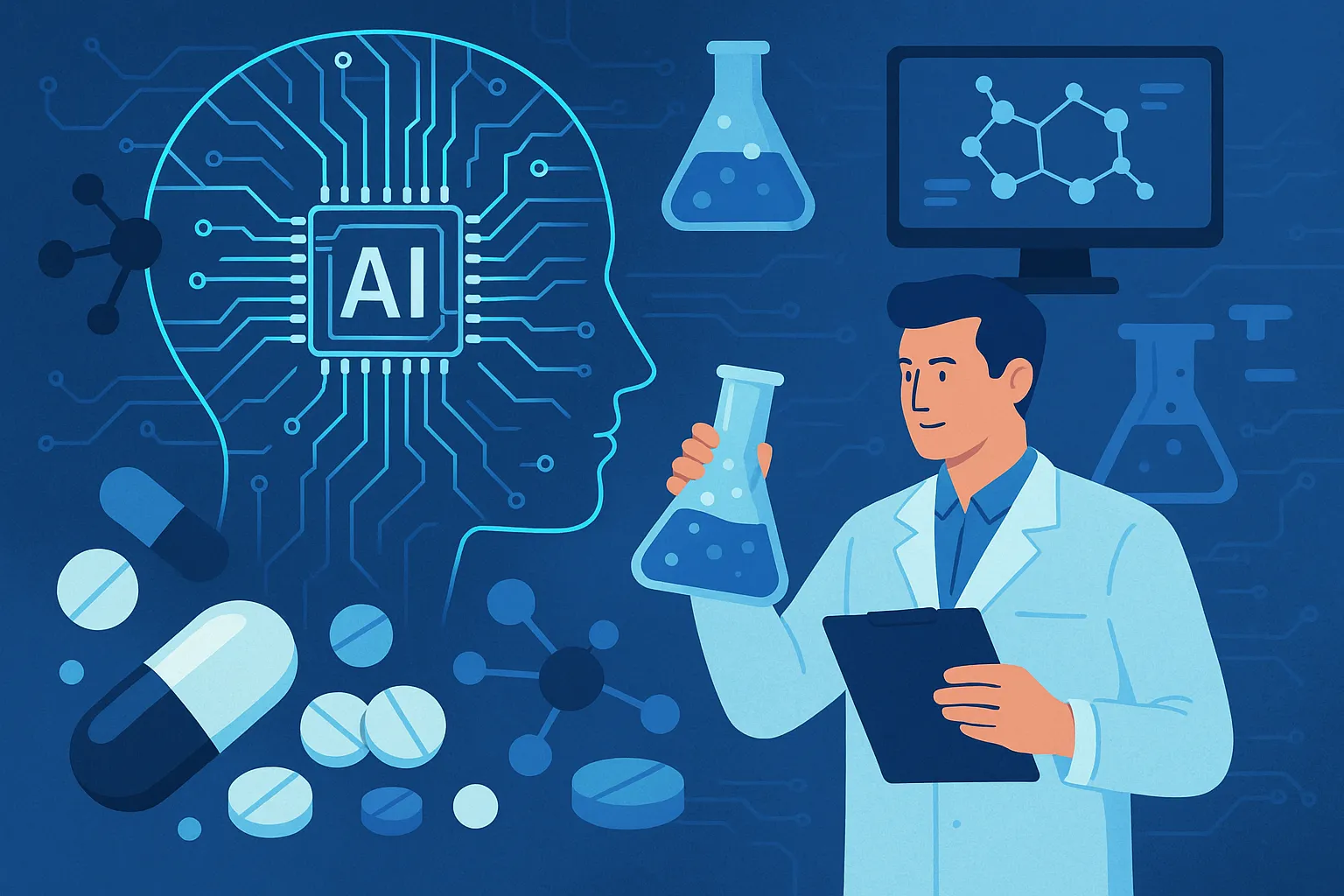
Over the past decade, the pharmaceutical industry has transitioned from a reliance on trial and error to a data-driven approach. Artificial intelligence (AI) and machine learning (ML) have become key drivers for discovering new drug molecules, predicting their behavior, and reducing the time and cost from lab to clinic.
Where does AI add the most value?
Molecular prospecting: Generative algorithms that suggest “manufacturable” chemical structures that fit the binding site of a biological target, with simultaneous improvements in potency, solubility, and selectivity.
Toxicity and pharmacokinetic prediction: Models that predict early ADMET (absorption, distribution, metabolism, elimination, toxicity) properties to filter out candidates before costly trials.
Drug repurposing: Analyzing large clinical and genetic databases to uncover new uses for approved drugs, cutting years of development time.
Clinical trial design: Selecting the most appropriate patient populations, defining smart endpoints, and simulating withdrawal and adherence scenarios to improve statistical power.
Lab Operations: Integrating AI with Laboratory Information Management Systems (LIMS) and High-Throughput Robotics to Drive More “Learned” Experiments
How Do Models Work in Practice?
Structural Deep Learning: Links the 3D shape of a protein with its drug candidate’s binding energy to predict binding energy.
Graphic Molecular Models (GNNs): Represent molecules as nodes and links and learn their properties directly from the structure.
Constrained Generation: Imposing artificial constraints (such as manufacturability rules and proprietary rights) when proposing compounds.
Challenges and Governance
Data Bias and Explainability: Robust but “black box” results. Solution: Interpretable models, diverse datasets, and external validation.
Integration under GxP: Systems must adhere to good quality practices and maintain a clear audit trail.
The Prediction-Experiment Gap: Wet Lab Validation Remains Critical; the Best Software Couples Prediction with Rapid Learning-Experiment Cycles.
What Lies Ahead?
Data partnerships: Secure environments for pooling multi-party data without exposing it (federated learning).
Digital twins of the molecule and target: Closed loops that learn in real time from lab results.
Therapeutic personalization: Aligning molecular design with a patient’s genetic and microbiome signature.